CFP: The People’s Political Economy of Computing
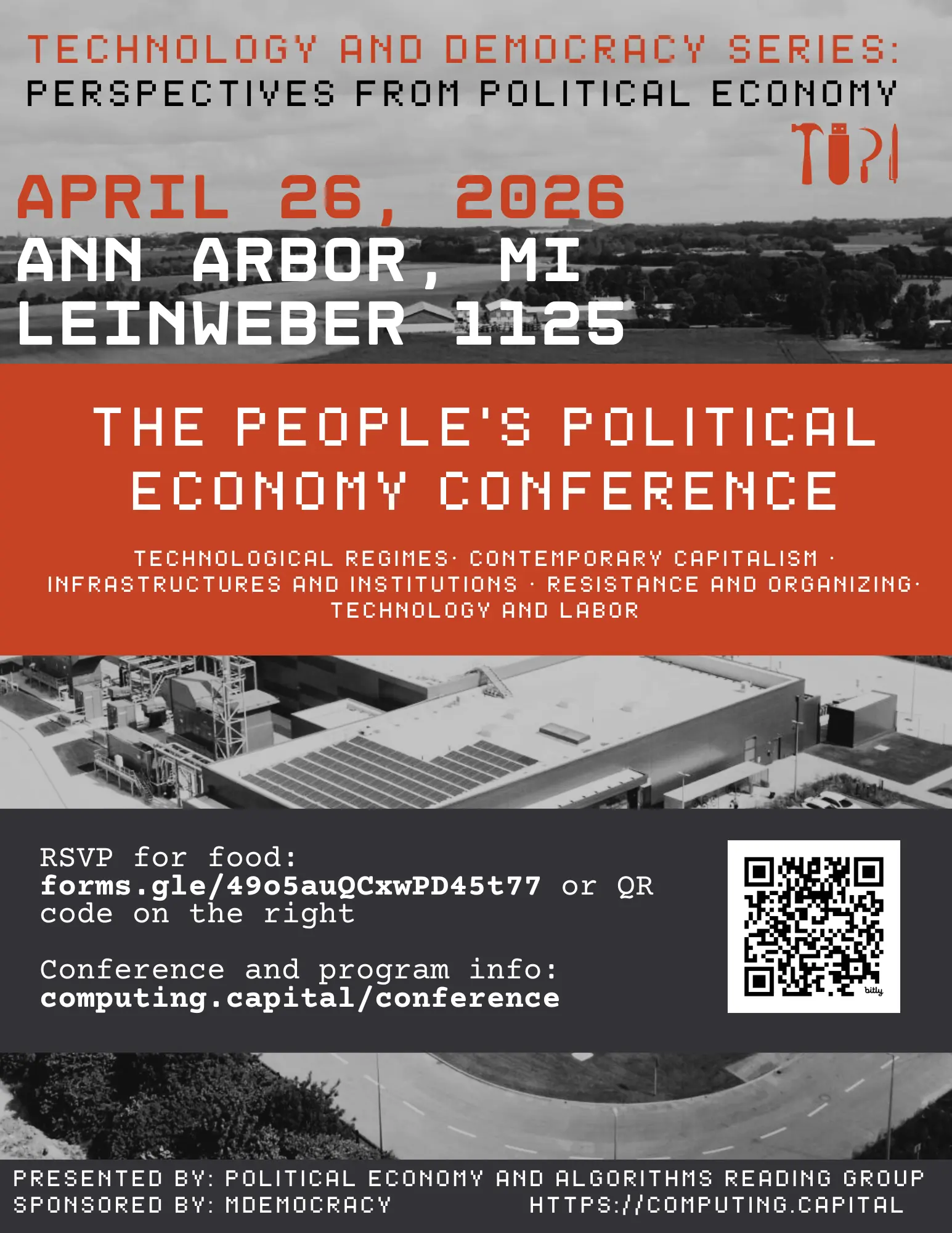
A one day conference presented by the Political Economy and Algorithms Collective, as part of our series on Technology and Democracy: Perspectives from Political Economy
The Political Economy and Algorithms Collective is hosting a one-day conference on April 26* in Ann Arbor, Michigan. This conference will bring together researchers and organizers that are investigating the political economy of algorithms and computing, with the goals of identifying how we might bridge technology-related movements and struggles, and what the role of theory and the intellectual in a liberatory movement can/should be.
*Please be aware that the conference was rescheduled from May 2 to April 26.
We are soliciting submissions (in the form of position papers) with the intent to invite at least twelve presenters. Attendees may present a lightning talk or participate in a panel in conversation with others.
NOTE: Submission window is closed but registration for attendance is open!
All accepted position papers will be published on our website: computing.capital.
Information for Attendees
Registration is now open for attendees!
Please complete this registration form.
Conference Program
| Time | LCSIB 1125 (big room) | LCSIB 1240 | LCSIB 1290 |
|---|---|---|---|
| 9 – 9:30 AM | ☕ Registration opens; breakfast & coffee | ||
| 9:30 – 10:30 AM | 📣 Welcome Remarks and Keynote: Michelle Martinez (LCSIB 1125) | ||
| 10:30 AM – 12 PM | S1: Contemporary Capitalism Theory | S2: Tech and Labor | Hangout: Postcards for Peace |
| 12 – 1 PM | 🍽️ Lunch | ||
| 1 – 2:30 PM | S3: Technological Regimes | S4: Infrastructures and Institutions | Hangout / Activities Table |
| 2:30–3:30 PM | 🤝 Mixer | ☕ Coffee break | Hangout / Activities Table |
| 3:30–5 PM | S5: Resistance and Organizing | — | — |
| 5 PM onwards | 🍽️ Dinner (with additional programming) | ||
Session Details
Welcome Remarks and KeynoteKeynote by Michelle Martinez on environmental justice, data centers, and political organizing.
Michelle Martinez is the inaugural director of the Tishman Center for Social Justice and the Environment at SEAS. She has 15 years of experience of practicing environmental justice in her hometown of Detroit.
S1: Contemporary Capitalism TheoryThis session examines capitalism’s evolving forms in the contemporary age, interrogating (dis)continuities in our understanding of capitalism and its relation to modern technology, science, and politics. Central to this is the question of whether we are witnessing the same old order under new guises, or something genuinely new.
Works in discussion:
- · Capitalism or Technofeudalism? Notes on the debate, a third world perspective
- · Egotistical Calculation: A Historical Materialist Critique of Statistical Epistemology
- · Silicon Valley and the Security State, 1999–2005
- · University Complicity in AI-Driven Fascism
This session investigates the material conditions of technology work and the political economies that structure them, from platform labor in the Global South to the class dynamics of the engineering profession.
Works in discussion:
- · Data Work in Kenya and the Regime of Entrapment
- · Institutional Entrepreneurship as a Response to Regulatory Abandonment: The Case of Web Accessibility
- · The Class Interests and Moral Motivations of the Shareholding Engineer
- · The PATCO Strike and the Development of Centralized Air Flow Technology
This session interrogates the political and ideological dimensions of emerging technological regimes, asking who benefits from their rapid expansion and on whose terms the future of society is being built.
Works in discussion:
- · Agentic AI: User Empowerment or Infrastructures of Power?
- · Ultraprocessed Information and Generative Deserts: Parallels Between the History of Ultraprocessed Foods and Generative AI
- · What's the Deal with AI Safety?
- · Working Towards Understanding the Political Ideology of Technological Projects
This session explores how technical and bureucratic infrastructures shape (and are shaped by) institutional power, from rural economies to university governance to postcolonial urban development.
Works in discussion:
- · Crisis and Rural Innovation
- · On the Technical Infrastructure for Administrative Abolition: Exploring the Systemic Design Process for Democratic Self-Management of Universities
- · Spectres of Postcolonial Socialist Publics in a Tech City: The Case of Deindustrialising Bangalore
- · Teaching the Political Economy of Artificial Intelligence: Reports from Public School Classrooms
This session brings together work on how peoples, workers, and activists organize resistance with or in spite of technology, from cloud chokepoints to abolitionist practice.
Works in discussion:
- · Digital Infrastructural Resistance in Gaza
- · Chokepoints in the Cloud: Generative Potential of Breakdown in Cloud Infrastructures
- · Destruction as Design
- · Digital Defense as Abolitionist Practice
Information for Contributors
Format
2 page limit (without citations): position paper, extended abstract, etc. We prefer that authors use the ACM small template.
Submission process
Upload your submission here. Questions can be directed to political-economy-and-algorithms-requests at umich.edu.
Deadline
UPDATE! Submissions will be accepted on a rolling basis until Feb 15, 11:59PM.
Attending and Logistics
Date: Sunday, April 26, 2026
Location: Leinweber Building, University of Michigan, Ann Arbor, Michigan, United States
Cost: No attendance or registration fees
Travel: Nearest airport is DTW (25 miles, accessible by bus), nearest train station is Ann Arbor Amtrak (2 miles)
Financial Support: Funds are available for round-trip travel to Ann Arbor from the US and Canada for accepted presenters. Organizers will be in contact with presenters to arrange travel and lodging plans.